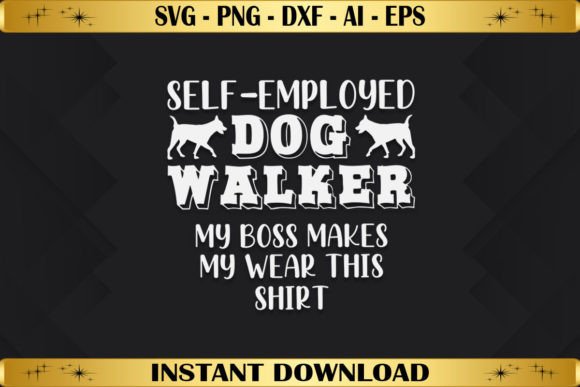
Self Employed Dog Walker Design Review
As a professional embroidery digitizer and product reviewer, I approach every new graphic with a specific question: will this actually stitch out well on fabric? When evaluating the Self Employed Dog Walker - Pet Sitter design, my focus shifts immediately from screen aesthetics to needle performance. This graphic is marketed primarily within T-Shirt Designs and Graphics categories, often arriving as a print-ready vector set including SVG, PNG, DXF, AI, and EPS files. However, for those of us in the machine embroidery space, these vector assets serve as the critical blueprint for digitizing or direct-to-garment applications. My assessment below treats this design not just as a digital download, but as a foundational element for real-world commercial embroidery projects and handmade products.
Visual Personality and First Impressions
The initial mood of the Self Employed Dog Walker - Pet Sitter graphic strikes a balance between professional reliability and playful warmth. For an embroidery designer, this duality is essential. A design that is too cartoonish may undermine the trust required for a pet care business, while one that is too corporate lacks the heart of a handmade product. This layout typically features clean lines and recognizable iconography associated with dog walking, such as leashes, paw prints, or stylized canine silhouettes.
From a digitizing perspective, the shape and layout suggest excellent versatility. The composition appears balanced enough to work as a left-chest logo on custom apparel or a centered motif on a tote bag design. The visual weight seems distributed evenly, which is crucial when converting vectors into stitch data. If the original artwork relies heavily on thin lines, I would immediately plan to convert those elements into running stitches or satin stitches depending on the final size. The clarity of the design indicates it was created with scalability in mind, a non-negotiable trait for any digital embroidery file intended for varied merchandise.
Real-World Application: The Canvas Tote Test
To truly evaluate this asset, I mentally placed it into a recent client scenario: creating branded merchandise for a local pet sitting startup. The goal was a heavy-duty canvas tote bag that clients could use for carrying treats, waste bags, and small supplies. In this context, the Self Employed Dog Walker - Pet Sitter design needs to perform under specific physical constraints.
Canvas is a textured, stable fabric that generally accepts embroidery well, but it demands adequate stabilizer to prevent puckering around dense fill stitch areas. If utilizing this graphic for a tote bag design, I would recommend testing the stitch density first. Vector files do not contain stitch information, so if you are digitizing this yourself or hiring a digitizer, ensure the fill patterns have appropriate underlay. Without proper underlay on canvas, the design can sink into the weave, losing definition. For this specific project, the design’s bold shapes would translate beautifully into a combination of satin stitch borders and tatami fills, creating a high-quality embroidered patch look directly on the bag. This application transforms a simple graphic into a tangible brand asset that builds customer trust through perceived quality.
Navigating Fabric Limitations and Hoop Sizes
While the Self Employed Dog Walker - Pet Sitter graphic is versatile, certain applications require caution. As an experienced reviewer, I must highlight where this design type faces challenges. Small hoop sizes are the primary concern. If the design includes intricate details like individual toes on a paw or fine text describing services, scaling it down for a baby embroidery project or a cap may result in lost detail or thread breaks.
Caps present another hurdle due to their curved surface and structured front panels. If the design is tall or vertically oriented, it may distort during stitching. I would advise modifying the aspect ratio specifically for headwear or selecting only the central icon portion of the Self Employed Dog Walker - Pet Sitter graphic for caps. Similarly, stretchy fabrics like performance tees or lightweight knits demand careful stabilizer selection. A cut-away stabilizer is mandatory here to maintain registration between color changes. If the design has widely spaced elements, the fabric may shift between stops, causing misalignment. Always test on scrap fabric that matches your production material before committing to a full run of sweatshirt embroidery or custom apparel.
Dark fabrics also warrant attention. If the original vector art uses light colors or gradients, you must consider how this translates to thread. Unlike printing, embroidery does not blend colors seamlessly. You may need to add a white underlay base or adjust the color palette entirely to ensure the design pops against navy or black garments. This adaptation is vital for maintaining visual appeal and professionalism in finished products.
Commercial Value and Brand Consistency
For Etsy sellers and small shop owners, the value of this design extends beyond a single stitch-out. It serves as a cornerstone for brand consistency across multiple mediums. Because the Self Employed Dog Walker - Pet Sitter package includes AI and EPS files, it allows for seamless integration between digital mockups and physical goods. You can create accurate printable mockups for your listings using the same source art used for production, reducing customer confusion and returns.
The professional presentation of this design directly impacts buyer engagement. In the pet service niche, customers equate neat, clear branding with safety and competence. A jagged, poorly registered, or overly dense embroidery job suggests carelessness. Conversely, a crisp execution of this design signals attention to detail. Whether applied to holiday gifts, personalized gifts for staff, or commercial embroidery for uniforms, the design acts as a silent ambassador for the business. Its adaptability makes it a strong candidate for expanding product lines—from aprons for grooming stations to pillow covers for pet-friendly Airbnbs—without losing thematic coherence.
Essential Designer Notes for Production
Before loading this design into your machine or sending it to a contract embroiderer, adhere to these practical checkpoints:
- Verify Licensing: Confirm whether your purchase of the Self Employed Dog Walker - Pet Sitter files grants rights for commercial embroidery on finished products versus just digital resale. This distinction is critical for Etsy sellers and craft business owners.
- Digitization Check: Remember that SVG and DXF are vector formats, not stitch files. Unless a specific embroidery file format (like DST, PES, or JEF) is included, you must digitize this artwork. Do not assume auto-digitizing software will handle the nuances of pet-themed graphics perfectly; manual adjustment is often needed for optimal stitch flow.
- Thread Color Contrast: Test the design in both black-and-white and full-color simulations. Ensure outline colors provide sufficient contrast against fill areas, especially if stitching on patterned or textured backgrounds.
- Stabilizer Strategy: Match your stabilizer to the end-use. Use tear-away for stable items like tea towels, but switch to cut-away for any custom apparel or stretchy knitwear to preserve the design's integrity after washing.
- Detail Inspection: Zoom in to 400% on the vector file before digitizing. Identify any gaps smaller than 1mm and close them. Tiny gaps in vectors become massive headaches in embroidery, leading to registration errors or unintended jumps.
- Mockup Accuracy: Utilize the included PNG file for digital previews, but always photograph a real stitch-out for your main listing image. Customers in the handmade market value authenticity and want to see actual thread texture, not just a flat digital rendering.
Ultimately, the Self Employed Dog Walker - Pet Sitter design offers a robust foundation for creative entrepreneurs. Its strength lies in its clean aesthetic and multi-format availability, supporting everything from rapid prototyping to full-scale commercial production. By respecting the technical realities of translating vector art into thread, makers can leverage this graphic to produce high-value, professional merchandise that resonates with pet lovers and business owners alike. Always prioritize testing and material compatibility to ensure your finished product reflects the quality your brand promises.